

Facing fears, finding friendship, and taking risks are at the heart of Bea Mullins Takes a Shot, a hilarious and heartfelt middle-grade novel from debut author and astronomer, Emily Deibert. As the Winter Olympics concluded with Team Canada’s women’s and men’s hockey teams earning silver medals, Bea’s story feels especially timely as young students across Canada reflect on elite athletes and Para athletes chasing big dreams on the ice. Keep reading for our exclusive interview with Emily Deibert, where she shares the inspiration behind her debut novel and what it means to see Bea’s story connect with readers across Canada.
When seventh grader Bea Mullins is unexpectedly forced to join her school’s first all-girls hockey team, she discovers that the rink can be a place of belonging, confidence, and first crushes, not just pressure and embarrassment. Published by Penguin Random House, the book has been nominated for the 2026 Forest of Reading Silver Birch Fiction Award, recognizing outstanding Canadian stories for young readers in grades 4 to 6, and was also recognized as an Indigo Best Books of the Year selection in 2025.
Parents and educators will find Bea Mullins Takes a Shot especially meaningful for young readers navigating the challenges of middle school. With the Winter Olympics and Paralympic Games capturing global attention, many students may find themselves watching elite athletes compete and feeling inspired to try a new sport themselves. This story offers an encouraging reminder that every athlete starts somewhere, and that confidence is built through effort, not perfection. Through Bea’s journey, readers see how teamwork, inclusion, and persistence can transform fear into growth, both on and off the ice. That is why the in-person and online tutoring team at Teachers on Call recommends books that are a timely and relatable read for tweens who may be discovering a new interest in hockey or feeling inspired to take a chance on something unfamiliar.
Why the Forest of Reading Empowers the Next Generation of Readers
The Forest of Reading is Canada’s largest recreational reading program, connecting children and teens with curated Canadian books year after year. Organized by the Ontario Library Association, the program features multiple English and French award categories that celebrate Canadian authors and illustrators across age groups. What makes the Forest of Reading especially powerful is its student-driven model. Young readers across Canada read the nominated titles and vote for their favourites, giving them an active voice in the literary community. The program culminates with the Forest of Reading Festival in Toronto at the Harbourfront Centre (235 Queens Quay West, Toronto, ON M5J 2G8), where students, educators, and authors gather to celebrate stories that spark curiosity, confidence, and connection. As national moments like the Winter Olympics and Paralympic Games capture students’ attention and inspire new interests, programs like the Forest of Reading play an important role in helping young readers explore those passions through Canadian stories. At Teachers on Call, we are proud to support initiatives that encourage literacy, critical thinking, and student engagement through reading.
About the Debut Author and Astronomer: Meet Emily Deibert
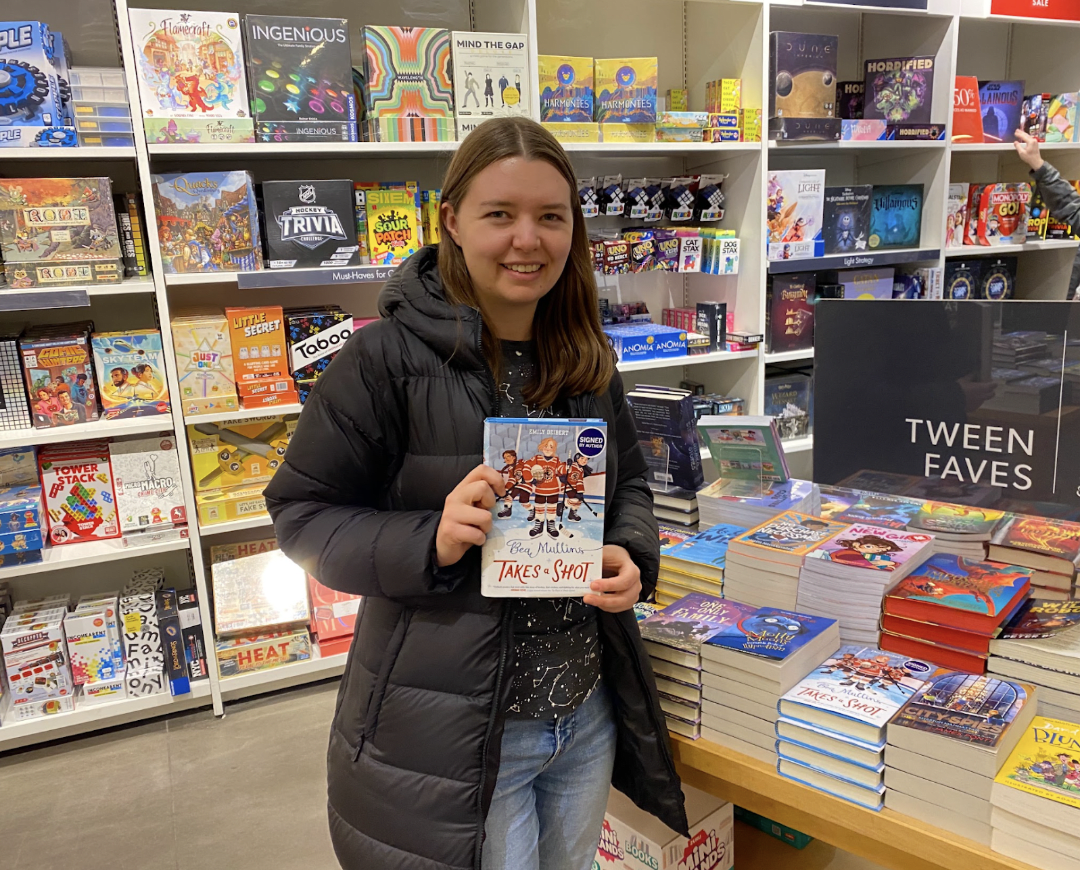
Emily Deibert is a Canadian author originally born in North Vancouver who grew up in Toronto, Ontario. Bea Mullins Takes a Shot is her debut novel. When she is not writing children’s books, Emily works as an astronomer studying exoplanets, blending creativity and science in her professional life.
Prior to starting her PhD, she completed an Honours Bachelor of Science in Astrophysics, English, and Mathematics from Victoria College at University of Toronto (73 Queen's Park Cres E, Toronto, ON M5S 1K7). Emily is currently a Banting Postdoctoral Fellow at the University of Waterloo/Waterloo Centre for Astrophysics (200 University Ave. W., Waterloo, Ontario, N2L 3G1).
Emily draws inspiration from her love of Toronto, its libraries, outdoor skating rinks, and the communities that helped shape her as a reader and storyteller.
Talking Hockey, Friendship, and First Chances with Emily Deibert
Bea Mullins Takes a Shot is your debut novel. What inspired you to tell Bea’s story, especially one centred on facing fears, forming friendships, and discovering unexpected strengths?
A lot of Bea’s story was inspired by my own journey towards facing my fears and learning to believe in myself—not only when I was 12 years old, but also as an adult! I’ve wanted to be an author for as long as I can remember, but before I wrote Bea Mullins Takes a Shot, I’d always been too scared to share my writing with anyone. A few years ago, however, I decided that I was finally going to take a shot on myself and my writing dreams. That decision led to me coming up with the story of a 12 year old girl who (like me!) was nervous about putting herself out there and facing potential failure. But just like Bea, I eventually learned that you really do miss 100% of the shots you don’t take.
I also wanted to create a story that was full of joy and friendship, and that helped tween readers feel seen. I hope readers will come away from the story feeling inspired to take a shot on themselves and their own dreams, too!
Bea starts out believing she is terrible at sports, yet her confidence grows as she spends more time with the team. How did your own experiences with hockey influence the humour and heart behind Bea’s athletic misadventures?
So many of Bea’s adventures (and misadventures!) on the Glenwood Geese hockey team were inspired by my own experiences on my high school girls hockey team, the Danforth Redhawks (athletic team for Danforth Collegiate and Technical Institute, 800 Greenwood Ave, Toronto, ON M4J 4B7). Like Bea’s team, my high school team didn’t initially have enough players, so they were willing to recruit anyone they could get. A few of my friends convinced me to join (even though I’d never played hockey before!) and in the beginning I was really worried about embarrassing myself. And then, at our very first game, I had to sub in for our goalie (who was sick)—and we wound up losing twelve-nothing! I was so mortified at first, but the rest of my teammates were just happy that we’d gotten to play, and they didn’t even care what the final score was. That experience really stuck with me, and inspired the support Bea feels from her own team. All of our hijinks in the locker room definitely inspired the humour in the book, too!
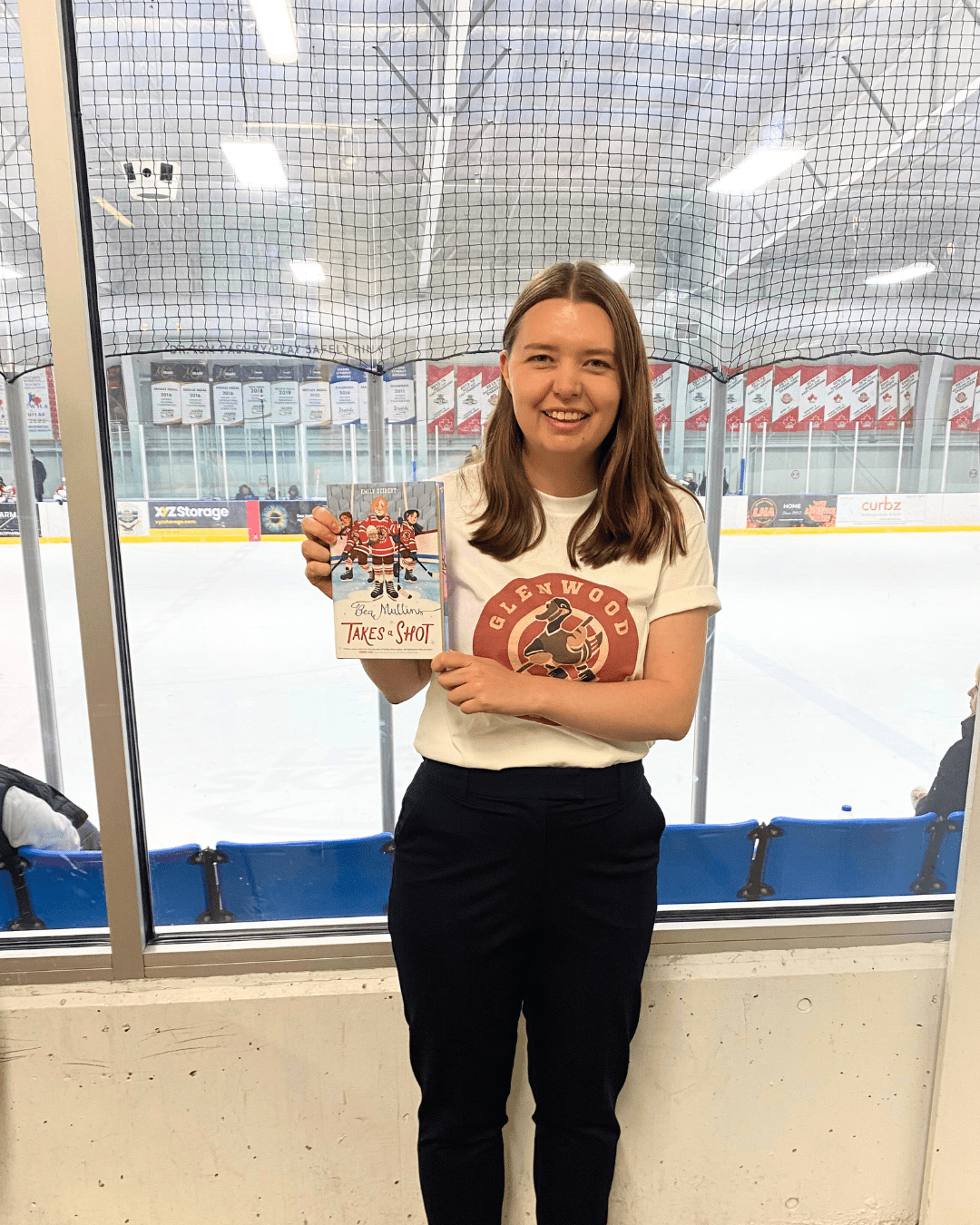
The Glenwood Geese become a powerful symbol of teamwork and friendship. How do you hope this story helps young readers understand the importance of supporting one another, especially when trying something new?
I was definitely a little competitive as a kid, but the older I got, the more I started to realize how rewarding it can be to work with other people rather than against them. My experience on my high school hockey team is a great example of that—rather than being upset that I’d let in so many goals, my teammates cheered me on and made me feel good about myself. If it hadn’t been for their support, I probably would’ve quit hockey after that very first game (and if I’d done that, I never would’ve been able to write Bea Mullins Takes a Shot!)
I hope that young readers will come away from Bea’s story understanding just how powerful that sort of support can be. We all start out as beginners when we’re trying something new, but a little support and encouragement can go a long way to making people feel included.
The friendship between Bea and Celia is full of loyalty, honesty, and moments of tension. How do you hope their relationship encourages conversations with young readers about communication, growing pains, and staying true to yourself?
Middle school can be such a difficult time—it was certainly one of the most difficult periods in my life!—but I also think it’s so full of opportunities for growth, development, and learning who you are and what’s important to you. When I was a tween, I dealt with losing friends because I was scared to face some of those challenges head-on. With Bea and Celia, it was really important to me to show readers that while you may experience moments of tension with friends, it’s possible to get through those moments—and your friendship might emerge even stronger. Although it takes Bea a bit of time to be able to communicate openly and honestly with Celia, she’s met with overwhelming support when she does. I hope readers will be able to learn from both girls, and come away from the book feeling confident to communicate about the things that are important to them, too.
Many teachers and librarians look for books that spark discussion. What activities or classroom conversations do you think Bea Mullins Takes a Shot could inspire, especially around confidence, inclusion, and trying new challenges?
I hope that Bea Mullins Takes a Shot might inspire classroom conversations around inclusion in sports (or, more broadly, inclusion in general). With the Winter Olympics this year, I think teachers and librarians have an excellent opportunity to talk with their students about who we see represented in sports, and how we can make sports more inclusive. Hockey, for example, has traditionally been very male-dominated, but there are so many inspiring women and gender diverse hockey players out there. In my Author’s Note at the end of Bea Mullins Takes a Shot, I included links to some resources that might help spark these sorts of discussions.
I also hope that the book will inspire discussions around confidence and trying new things. One of the main lessons Bea learns in the story is the idea that you miss 100% of the shots you don’t take. While this quote was initially said in the context of hockey, it’s an idea that can apply to anything in life (like it did for my writing career, for example!). I think it would be great for students to reflect on how this quote might apply to their own goals and dreams, and to think about the shots they want to take in their own lives, too.
Lastly, I hope that teachers and librarians will take a look at the wonderful activities and discussion guides for Bea Mullins Takes a Shot developed by the Forest of Reading committee!
You write children’s books by day and work as an astronomer by night, which is a fascinating combination. How do these two creative and scientific worlds influence your writing process and the stories you are drawn to tell?
In some ways, my journey into astronomy was a lot like Bea’s journey into hockey. I never thought of myself as a “science person” when I was younger, and definitely never thought it was something I’d pursue in the future—in fact, I didn’t even take grade 12 physics in high school! But in my first year of university (where I was studying English literature), I enrolled in an introductory astronomy course for breadth, and was incredibly inspired by my professors and their passion for the field. I decided to take a few more astronomy courses, and then a few more, until eventually I wound up continuing on to get my PhD in astronomy and astrophysics from the University of Toronto.
Even though writing and astronomy might seem pretty different, I think they’re both careers that require a great deal of creativity. In my work as an astronomer, I study exoplanets—planets outside our Solar System, most of which are totally different from the Earth—and being able to think creatively really helps when it comes to imagining what these worlds might be like. Writing and astronomy are also both careers that people might imagine to be quite solitary—if you try to picture an astronomer, you might think of someone sitting alone at a telescope late at night—but in reality, one of my favourite things about both writing and astronomy is the fact that I get to work with so many wonderfully talented people. A lot of the support and friendship amongst Bea and her teammates was inspired by the “teams” of astronomers I’ve gotten to work with all over the world.
Astronomy (and STEM in general) is also an area that—like hockey—hasn’t always been inclusive. Some of my experiences in the field were part of what drew me towards writing about inequities in sports in Bea Mullins Takes a Shot. And while my first book doesn’t focus on astronomy, I’m definitely hoping to write an astronomy-themed book at some point in the future!
You are originally from Vancouver and later moved to Toronto as a child. Are there any places you loved to visit when you were growing up that helped inspire your creative side or encouraged your love of storytelling?
I was born in North Vancouver but moved to Toronto when I was around 4 years old, and so much of Bea Mullins Takes a Shot was inspired by my love of the city. I definitely owe a lot of my love of storytelling to the Toronto Public Library, and to the Beaches branch (2161 Queen St E, Toronto, ON M4L 1J1) in particular—in the summers I used to spend all day in that library branch, reading as many books as I could, and even writing some of my very first novels there (by hand)! Later, as a young adult, I had a job at the St Lawrence branch (171 Front St E, Toronto, ON M5A 4H3), so the TPL definitely holds a special place in my heart. It has been an absolute dream come true to find copies of Bea Mullins Takes a Shot at different branches around the city!
For this book in particular, I also got a lot of inspiration from Toronto’s many outdoor skating rinks. I used to live near the Barbara Ann Scott Ice Trail at College Park (33 College St, Toronto, ON M5G 2B3), and it was out there that I first came up with the idea for Bea Mullins Takes a Shot. One of my favourite scenes in the book was also inspired by the Bentway Skate Trail underneath the Gardiner Expressway (250 Fort York Blvd, Toronto, ON M5V 3K9). I take a lot of inspiration from being outdoors, and I’m grateful that Toronto has so many great outdoor spaces to explore!
Congratulations on being a nominee for the 2026 Forest of Reading Silver Birch Fiction Award! What does this recognition mean to you as a debut author, and what do you hope young readers across Canada will connect with most as they discover your book through the program?
Thank you! Being nominated for the 2026 Forest of Reading Silver Birch Fiction Award has truly been a dream come true. I actually used to participate in the Forest of Reading program as a reader when I was growing up, and I attended the Forest of Reading Festival at the Toronto Harbourfront Centre many times as a kid. I can remember sitting in the audience and dreaming of being up on that stage one day—and having that dream come true with my debut novel is an incredible honour.
I hope that young readers across Canada who pick up Bea Mullins Takes a Shot will feel seen and supported by the messages in the story. One of my main goals when I was writing this book was to create an environment full of warmth, friendship, and support. I want readers to come away from Bea Mullins Takes a Shot feeling encouraged to pursue their dreams, and to take their own shots on themselves and the things that are important to them.
~
Bea Mullins Takes a Shot is a joyful and affirming debut that reminds young readers that confidence grows through connection, and that sometimes the bravest thing you can do is simply try. We are thrilled to celebrate Emily Deibert’s nomination and to share this standout Forest of Reading title with families, educators, and young readers across Canada. Stay tuned for more interviews with 2026 Forest of Reading nominated authors and illustrators in our Hooked on Books series. Interested in more books for young sports enthusiasts? Check out Angela Ahn’s Julia on the Go! The Big Splash, Danny Ramadan’s Salma Joins the Team or Ali Hoops by Sportsnet Anchor, Evanka Osmak.
Related Articles View All
Forest of Reading 2027 Nominees Announced: Discover Canadian Children’s Books in English and French
The Forest of Reading 2027 nominees are here! This year’s lineup celebrates diverse Canadian authors and illustrators from coast to coast, with books in English and French for readers of all ages. Explore the full list and discover which stories students across Canada will be reading—and voting for—this spring.
From Stop-Motion to Stories of Freedom: Family Learning at Doors Open Chatham-Kent
Explore stop-motion animation, Black history, art, nature and more at 13 Doors Open Chatham-Kent sites offering family-friendly learning across the region.
From the High Arctic to a Historic Schoolhouse: Family Learning at Doors Open Quinte West
Explore the High Arctic, aviation history, dinosaurs and more at 10 Doors Open Quinte West sites offering hands-on learning for the whole family.
