

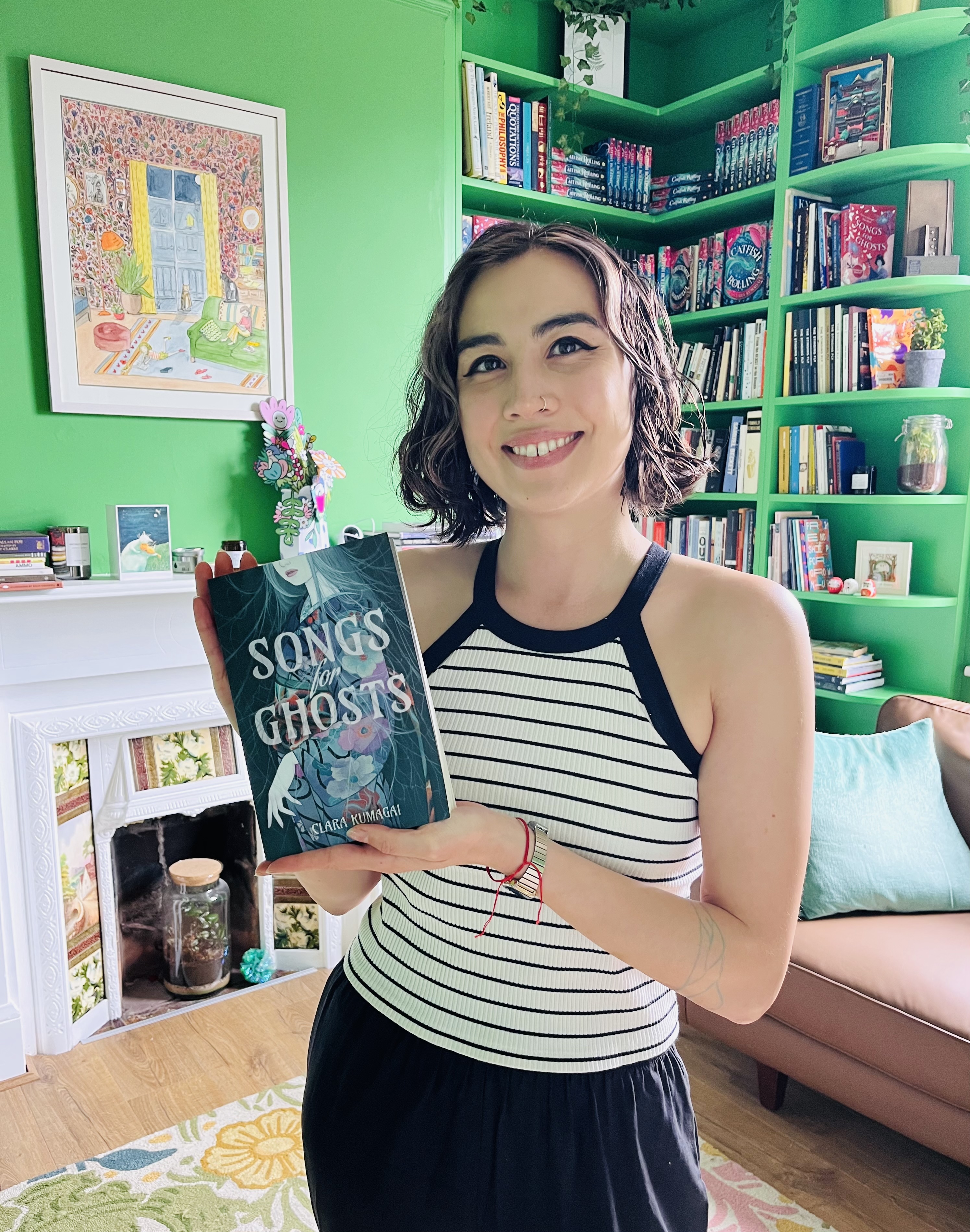
In Songs for Ghosts, Clara Kumagai weaves a haunting and heartfelt story that blends coming-of-age discovery with history, romance and the supernatural. Nominated for the 2026 White Pine Award) through the Forest of Reading program, this compelling novel for high school readers explores themes of love, loss, identity and the lingering echoes of the past. Recognized for its poetic prose and rich historical fiction, the story invites readers into both a contemporary teen’s emotional journey and a century-old voice from Nagasaki, Japan. Inspired by Madama Butterfly by Giacomo Puccini and rooted in Japanese history. Keep reading for an exclusive interview with author Clara Kumagai on the inspiration and themes behind Songs for Ghosts.
Songs for Ghosts is a meaningful selection for teen readers, recognized as a nominee for the 2026 White Pine Award, which celebrates outstanding fiction for students in grades 9 to 12 across Canada, while also reflecting the growing popularity of young adult literature among adult readers. Known for its poetic prose, the novel offers a rich opportunity to explore language in a more expressive way, where poetic prose blends the rhythm, imagery, and emotional depth of poetry with narrative storytelling. This makes it an excellent choice during National Poetry Month in April, within classroom poetry units, or anytime readers are looking to deepen their appreciation of language. Through its exploration of grief, cultural connection, and self-discovery, the story invites thoughtful reflection and meaningful discussion around history, empathy, and personal identity in a deeply accessible way. Fans of poetry will also enjoy exploring our past Hooked on Books feature with Charlotte Collins on how poetry supports youth mental health, and can keep reading for our exclusive interview with Clara Kumagai.
Why the Forest of Reading Continues to Spark a Love of Books
The Forest of Reading is Canada’s largest recreational reading program, inspiring young readers across the country to explore outstanding Canadian literature each year. Organized by the Ontario Library Association, the program features multiple award categories in English and French, celebrating stories for every age group. What makes it unique is that students themselves vote for their favourite books, giving them a powerful voice in choosing the winners. The experience culminates at the Forest of Reading Festival held at Harbourfront Centre (235 Queens Quay West, Toronto, ON M5J 2G8), where thousands of students, teachers and fans gather to celebrate books and meet the creators behind them. At Teachers on Call, our online and in-home tutoring service is proud to champion programs that foster literacy, curiosity and a lifelong love of reading.
About the Book
Songs for Ghosts follows seventeen-year-old Adam who is struggling with a recent breakup and the prospect of a long, uncomfortable summer at home when he discovers a diary hidden in his attic. Written in 1911 by a young woman in Nagasaki, Japan, the diary draws him into a powerful story of love and longing. As Adam becomes increasingly absorbed, he begins to sense a ghostly presence tied to the diary’s past. Blending a coming-of-age narrative with historical insight and supernatural elements, Songs for Ghosts explores grief, cultural identity and the enduring impact of history, including the legacy of war on Nagasaki. In October 2025, CBC named Songs for Ghosts one of the B.C. books to cozy up with this fall.

About the Author: Meet Clara Kumagai
Clara Kumagai is from Vancouver, British Columbia, Japan and Ireland. She is a writer of fiction and nonfiction for both adults and young people. Her debut YA novel, Catfish Rolling, was named as a Best Book of 2023 by The Irish Times, the Observer and Waterstones. Catfish Rolling was nominated for the YOTO Carnegie Award and received the 2024 KPMG Children’s Books Ireland Book of the Year Award. Her second YA novel, Songs for Ghosts, was published in 2025, and received starred reviews from Booklist and Kirkus. It was named one of the Best Irish Books of 2025 by Children’s Books Ireland, and one of the Best Canadian Books of 2025. It has been nominated for the 2026 YOTO Carnegie Award and the White Pine Award. Clara lives and writes in Ireland.
Read our Exclusive Interview with Clara Kumagai
Songs for Ghosts blends coming of age storytelling with history, romance and the supernatural. What first inspired you to bring these elements together in Adam’s journey?
I saw Madama Butterfly in Vancouver in 2016, and I was left wondering about two stories I felt were untold, the heroine Cio-Cio-san’s and her son’s. This was particularly because Cio-Cio-san’s son is Japanese-American, and it made me think about what his life would be like, growing up in the US in the early 1900s. I wrote a short story afterwards from the son’s point of view as he begins to be visited by a ghost but it never quite worked, and then years later it became a starting point for Songs for Ghosts. The diary element came about because I wanted the diary to relate her own experiences and for her to tell her own story, but I also wanted Adam to be able to read and connect with it directly.
The diary Adam discovers is deeply tied to Nagasaki in 1911 and becomes a powerful connection across time. What drew you to this historical moment, and how did you approach weaving it into a contemporary YA narrative?
Madama Butterfly was first performed in 1904, but in Songs for Ghosts the diary begins in 1911 (while Adam’s narrative takes place today). I set it in 1911 because it was the beginning of a time of change for Japan and how it related to other countries, and also because it was the year that a feminist magazine called Seitō was founded by five women. This magazine was really pioneering and gave voice to women who wanted to write about a range of contemporary social issues. It plays a part in the novel and I also read articles from it in order to get an idea of voice and writing style at the time.
Themes of longing, identity and complicated love run throughout the novel. What do you hope young readers will take away from Adam’s emotional journey and from the story written by the young woman in the diary?
For Adam, a lot of his emotional journey is about finding connections, with other people and with his Japanese heritage. For the Japanese part, this means doing a summer homestay in Nagasaki, where he is not just learning Japanese language but learning about place, history and culture. With other people, that ranges from romantic relationships to family to friendships, and he makes plenty of mistakes with all of these. But that’s very natural. The more important thing is that he works to learn from these mistakes and tries to make them right. In many ways, the diary writer is also learning about relationships and connections with people, and finding her place in the wider world. But what I also wanted to show was that the adults in the book are also learning, understanding and growing. That doesn’t end when you stop being a teenager.
Your writing is known for poetic prose and immersive atmosphere. Can you share a bit about your creative process and how you crafted the tone and emotional resonance of Songs for Ghosts?
I’m usually led by voice in my writing, so that’s generally a starting point for me. In Songs for Ghosts, one of the useful elements is that Adam and the diary writer are separated by over a hundred years, so their way of speaking, the language they use, the vocabulary, is naturally very different. Adam’s story is told in first person, so it’s immediate and the reader is right in his head. For the diary writer, she is recounting her experiences, ideas and reflections in a much more intentional way. The diary is addressed to her grandmother, which I found was a good way to direct her writing and make it more conversational, and this also helped with tone and storytelling style. For both character voice and atmosphere, I need to consider their context, including personality, society, home and environment. I had to do a lot of research. For the ghostly elements I really had to work on the atmosphere, because ghost stories are all about that, and need a creeping, eerie feel.
Songs for Ghosts has strong ties to Japanese history, as well as to Puccini’s Madama Butterfly. How did these influences shape the story, and how do you hope they enrich readers’ understanding of the themes?
Songs for Ghosts pulls on many Japanese stories, not just ghost stories and folklore but also a Japanese epic called The Tale of the Heike. I wanted the novel to have the feeling of echoes, of stories within stories and how they are passed on and shared. I would love if readers found an interest in these old stories and read more of them.
Teachers and librarians often look for YA novels that support conversations about identity, culture and emotional growth. How might Songs for Ghosts be used in the classroom to explore these topics with students?
I think that any element of the novel that sparks interest in readers is worth exploring and discussing. For identity and culture, we see how characters respond and learn through language and through encountering other cultures and stories. There is also a sense of history and how we can learn from it, both globally and within families.
The novel also explores family dynamics and the complexity of relationships. Are there moments in the book that might help spark discussions about communication and empathy between generations?
I didn’t set out to centre family as a theme, but that’s what it became. I wanted to show complex relationships with conflict, reckonings and resolutions. A lot of this depends on communication, which both young people and adults have to work at.
As someone with roots in Canada, Japan and Ireland, how does your multicultural background influence your storytelling?
Songs for Ghosts is very much tied to my identity as someone with Japanese heritage. I also wanted to show the diversity of people with Japanese heritage and that there is no one right way to belong to a culture. There is a richness in multiculturalism that shapes how I write.
Songs for Ghosts is a nominee for the 2026 White Pine Award. What does this recognition mean for you?
I am so honoured and overjoyed. The Forest of Reading Program encourages young people to read across Canada and I’m delighted to be a part of that. I hope readers connect with the book in their own personal way.
What is next for Clara Kumagai?
I’m working on a graphic novel text and a new YA novel, both set in Ireland and involving Irish folklore.
~
Songs for Ghosts is a beautifully layered novel that invites readers to reflect on identity, history and the connections that transcend time. Through Adam’s journey and the voice from the past, Clara Kumagai creates a story that lingers long after the final page. As a White Pine Award nominee, this compelling YA novel is sure to resonate with teen readers across Canada, making it a meaningful addition to both classrooms and home libraries. Looking for more supernatural, spooky, or fantasy reads? Check out our interview with Oakville, Ontario-born Joel A. Sutherland about his book Haunted Canada: Four Terrifying Tales or Bradford, Ontario author Nicki Pau Preto for her novel The Last Hope School for Magical Delinquents. For adult readers looking for an escape, check out our interview with Nisha J Tuli’s about her romantic fantasy series.
Related Articles View All
From True Crime to Forest Science: Family Learning at Doors Open Sault Ste. Marie
From true crime and forest science to Indigenous and military history, explore 17 fascinating sites during Doors Open Sault Ste. Marie.
From an 1870s Classroom to a Modern University Campus: Family Learning at Doors Open Markham
Explore Markham’s past and present during Doors Open Markham, with 17 sites offering family-friendly adventures in history, art, architecture, education and culture.
Splashing Into Marine Science: "Octopus Ocean" with Canadian Author Mark Leiren-Young
Dive into the fascinating world of octopuses with Canadian author Mark Leiren-Young. Discover how Octopus Ocean: Geniuses of the Deep brings marine science, animal intelligence and ocean conservation to life for young readers.
