

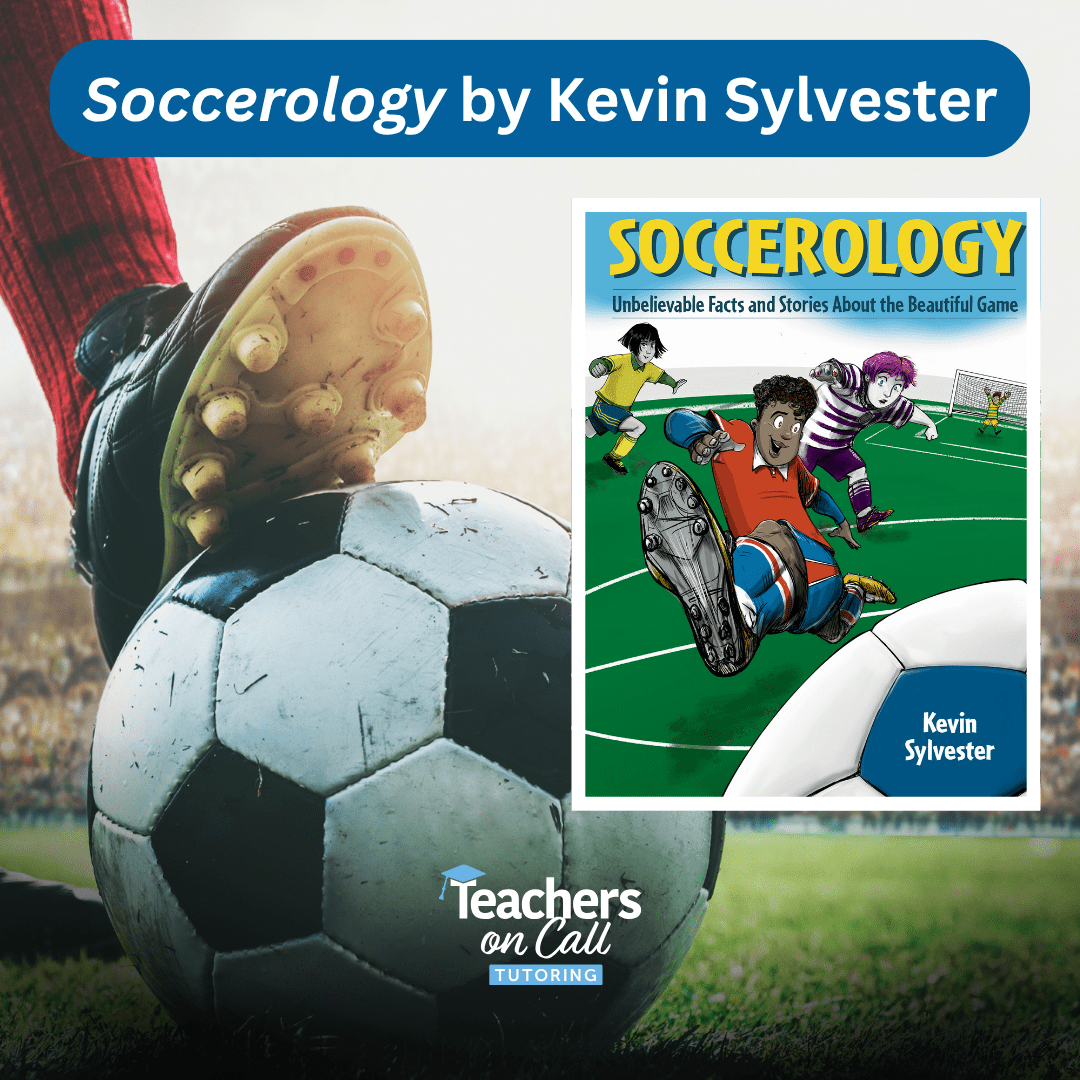
With the FIFA World Cup capturing the attention of soccer fans around the globe, there has never been a better time for young readers to dive deeper into the world's most popular sport. Soccerology: Unbelievable Facts and Stories About the Beautiful Game is an engaging and visually rich children’s nonfiction book written and illustrated by Canadian creator Kevin Sylvester and published by Annick Press. Filled with fascinating facts, colourful infographics, trailblazing athletes, and surprising stories from soccer history, Soccerology explores everything from the science behind a perfect kick to the social and cultural impact of the beautiful game. Kevin Sylvester’s latest book is sure to score with sports fans and curious learners alike, making it a winning read for elementary and middle school readers in grades 4 to 7. Keep reading for our exclusive interview with Toronto’s very own Kevin Sylvester, where he shares why science may be the most important subject in school for aspiring soccer players.
As families across Canada tune in to World Cup matches and celebrate the excitement of international competition, Soccerology offers an opportunity to extend that enthusiasm beyond the television screen. The book encourages young readers to think critically about sports, history, science, inclusion, and perseverance while learning about a game they may already love. Research has shown that families who watch sports together can create meaningful opportunities for conversation, connection, and shared learning, making books like Soccerology a natural extension of those experiences. The in-person and online tutoring team at Teachers on Call recommends books like this because they transform a love of soccer into a love of reading. Packed with fascinating facts, colourful illustrations, and surprising stories, Soccerology encourages young readers to stay curious, ask questions, and explore the world beyond the game itself.

About the Author: Kevin Sylvester
Canadian author, illustrator, and broadcaster Kevin Sylvester has built an impressive career creating engaging books for young readers. Based in Toronto, Ontario, Sylvester has written and illustrated numerous bestselling and award-winning titles, including the Neil Flambé series, MINRS, Basketballogy, and Baseballogy. Before becoming a full-time children's author, he worked as a journalist and broadcaster, covering major sporting events around the world, including eight Olympic Games. His ability to blend storytelling, humour, and educational content has made him one of Canada's most respected creators of nonfiction for children. Kevin is a current member of the Forest of Reading Advisory Committee and a 2024 winner of the Silver Birch Fiction Award for his book Apartment 713.
About the Book
Published by Annick Press, Soccerology: Unbelievable Facts and Stories About the Beautiful Game is an illustrated nonfiction title for readers ages 9 to 12. The book explores the history, science, culture, and global impact of soccer through colourful artwork, timelines, charts, and fascinating trivia. Readers will discover surprising records, historic firsts, unforgettable athletes, and the science behind the game while also examining important conversations around gender equality, race, and inclusion in sport. Whether readers are lifelong soccer fans or just discovering the game for the first time, Soccerology offers something new to learn on every page.
A World Cup Moment for Canadian Families
The timing of Soccerology could not be more fitting. Canada is currently welcoming the world as a host nation for FIFA World Cup matches, with games taking place at Toronto Stadium (BMO Field, 170 Princes' Boulevard, Toronto, Ontario, M6K 3C3) , and Vancouver Stadium (BC Place, 777 Pacific Boulevard, Vancouver, British Columbia, V6B 4Y8). As families gather to watch matches featuring the world's top athletes, Soccerology provides young readers with deeper context about the game's history, science, and global significance. It transforms World Cup excitement into an educational experience that encourages curiosity, critical thinking, and meaningful family discussions about sport and society.
This soccer compendium has already received positive attention from reviewers, including a thoughtful feature from CanLit for LittleCanadians that highlights its engaging blend of trivia, history, and illustration. It has also been included in Quill & Quire's roundup of summer reads celebrating the beautiful game. Readers interested in learning more about Kevin Sylvester and the inspiration behind Soccerology can also watch a recent interview with CBC, where he discusses the book and his passion for helping young readers explore the world through sports.
Check Out Our Exclusive Interview With Author Kevin Sylvester
Soccerology is packed with fascinating facts, stories, and colourful illustrations. What inspired you to create a book all about the world’s most popular sport, and why did now feel like the right time to tell these stories?
There has been a huge change in my school visits over the past few years. I write a lot about sports, and kids have always grilled me about my favourite hockey, baseball or basketball players or teams.
Now, the question that gets the biggest reaction is “who’s better, Messi or Ronaldo?” I mean there are shouts and screams for whatever answer I give. (For the record, I think it’s Messi… but I always tell the kids that I think Christine Sinclair (born in Burnaby, British Columbia) is the better and more impactful, or valuable, player for her teams.)
Through changing demographics, social media, etc., soccer has exploded in popularity.
So, with the World Cup coming to North America, the time was right to take the same approach to the game as I took in my other Annick “ology” books, Baseballogy and Basketballogy. There are facts even soccer-loving kids will be surprised by, and for kids who might be coming to soccer for the first time, easy to understand graphics and information.
As a former sports broadcaster who covered major sporting events, how did your experience reporting on sports shape the way you approached writing Soccerology for young readers?
I often say being a sportscaster was the perfect training for being a kids writer, because you have to appeal both to people who know the sport, and those who just want to hear an interesting story.
So I was always looking to tell stories that were generally interesting, not just interesting to sports fans. So I’d try not to focus on the scores, but delve into the history of sports, and the human side.
And I always liked silly stories too. They were the same stories I always liked to read about when I was a kid because they were funny and relatable. “Even star athletes make mistakes,” is a good lesson for kids to learn.
With the excitement of the upcoming FIFA World Cup building, what do you think it is about soccer that captures the imagination of people across so many different countries and cultures?
There are many reasons to love soccer and I tried to highlight some of them in the book. For example, Lionel Messi is basically the same height as me (5’6”). There are professional players who have been shorter. Soccer is not a sport that favours only one body type.
It allows for a variety, perhaps more than any other sport. In that way, soccer is inclusive in a way that other sports aren’t. Short kids can have heroes too (speaking as a former short kid and current short adult).
I also think that, here in North America, the women’s game has actually led the charge in growing the fans base. Canadian women, led by Christine Sinclair, have had incredible success, especially at the Olympics.
Ditto for the US women’s team, whose stars (Mia Hamm, Megan Rapinoe) are better known than their male counterparts.
I think it’s also interesting that, unlike many other sports, the history of the game isn’t just the history of colonial expansion, even though the sport as we know it started in England.
Each country has taken the basic game, including the basic rules, and made the game its own, developing a style of playing that is synonymous with it. Brazil is flashy and brilliant with individual players who have become legends.
Argentina has been led by two of the best players of all time - Messi and Maradona - but the team is best known for incredible passing and controlling the play.
Germany, the Netherlands, Italy… Nigerian, Ghana… and so on. It truly is a global game.
The book highlights important conversations around inclusion, gender, race, and the ways soccer has evolved over time. Why was it important for you to include these deeper social themes alongside the fun facts and trivia?
Simple stories don’t tell the whole story. See my previous answer about soccer as “British” vs. “Global.”
So, to truly understand a sport you can’t just look at the “good side”. There have been players who quit because of fan abuse over their race, gender, sexuality.
There have been deadly riots. Corruption at the highest levels has called some results into question. Girls are still not given the opportunities as boys to play the game. Kids understand complexity more than adults give them credit for, and they can also learn that you can love something like a sport, and wish it were better.
And, in the end, a book like this is intended to be a “rah rah” book, it’s intended to be fun AND educational.
I’m not here to advertise for FIFA or the pro sports organizations, or even for the game itself. I’m here to say, this sport is the most popular in the world (rivalled by Basketball) and there are good things and bad things that happen, and you better know about both.
How do you hope parents and educators might use Soccerology in the classroom or at home to spark conversations about teamwork, perseverance, and the global impact of sport?
When I talk about the book in school I start with a question. “What is the most important subject in school if you want to be good at soccer?”
The first few answers are always “phys ed, gym”, and they are not wrong. But eventually a student will suggest science and then I pounce. Because this is central to me for teaching kids how integrated EVERYTHING is. Science helps you get better at soccer because it teaches how to control things such as the Magnus Effect - the effect of spin and air pressure on a spherical object (ball). The best teams also use science to understand performance, injury risk, when to substitute a player… the effect of heat, altitude and so on.
But then there’s also the arts, which help train your brain for creative thinking. The best players are not just skilled, but creative and inventive in the way they think about the sport. Those are skills that don’t just come from playing a game, but from thinking critically.
And as for teamwork and so on, there are hundreds of studies about the value of a player who can pass, defend and score - someone who raises the entire team around them. See my earlier comments about Christine Sinclair.
Your illustrations and infographics make complex ideas easy to understand and engaging for young readers. How do you decide which moments or concepts are best told through pictures rather than words?
I’m a visual learner and always have been. Which means I test the text against my own ability to draw conclusions from it. If I’m confused, or if I can better understand a “percentage of players who” type of anecdote with a Venn diagram then I’ll do that.
I also try to sneak infographics into the illustrations - for example the hills the girl and the boy are running up in the section about Gender Gaps conforms pretty well to the numbers in the text, even though it’s not overtly presented as an infographic.
Throughout your career, you have explored an impressive range of genres and subjects, from sports and financial literacy to mysteries, science fiction, graphic novels, and picture books. What draws you to such diverse topics, and why is it important to introduce young readers to a variety of subjects through books?
I often talk to students about the skills you need to be good at something. And there are only two… curiosity and bravery. That’s it.
If you are curious you will dig and dig to learn more about the things you love. You will learn skills you didn’t even know you needed to learn. This is true no matter if you want to be a great soccer player or a great writer.
BUT curiosity gets knocked out of many people early, because they become afraid of making mistakes… of giving a wrong answer in school or making a mistake on the field in a game. Bravery doesn’t mean you only act when you are confident or convinced you are right… it’s being willing to make mistakes, even if someone might laugh at you.. or get mad at you.
But if you can keep asking questions and keep making mistakes, then you WILL get better at everything you care about.
I am lucky that I’m curious. If I don’t know about something (what do I know about money for example… I’m a kidlit writer living in Canada?!?) I want to learn about it.
What can readers expect next from Kevin Sylvester?
Along with Soccerology, I’m also still presenting my latest novel, Time Surfers, which has (so far) been nominated for a couple provincial awards. And I’m currently working on a series of soccer novels, similar to my Hockey Super-Six books, about a team of misfits called The Butts. The first book is due in Spring in 2027. I’m also working on what I hope will be a series of Canadian history books for very young readers. The first, not surprisingly, will be sports themed, about the Stanley Cup. And after that… who knows? I’ll keep asking questions and we’ll see what sticks.
~
As the FIFA World Cup inspires a new generation of soccer fans, Soccerology offers young readers an opportunity to look beyond the scoreboard and discover the stories, science, history, and people that have shaped the world's game. Kevin Sylvester's engaging blend of humour, research, and illustration makes complex ideas accessible while encouraging curiosity and critical thinking. Whether shared at home between family members, explored independently by a young soccer enthusiast, or used in classrooms to support literacy and inquiry-based learning, Soccerology is a winning addition to any reading list. It reminds readers that sport is about far more than competition—it's about community, learning, perseverance, and understanding the world around us.
Thank you for reading along. We hope you “get a kick” out of Soccerology. Looking for more books to encourage a love of reading with the young sports fans in your life? Check out our interview with debut author Emily Deibert for Bea Mullins Takes a Shot, or Salma Joins the Team by Danny Ramadan, or Ali Hoops by Evanka Osmak.
Related Articles View All
Forest of Reading 2027 Nominees Announced: Discover Canadian Children’s Books in English and French
The Forest of Reading 2027 nominees are here! This year’s lineup celebrates diverse Canadian authors and illustrators from coast to coast, with books in English and French for readers of all ages. Explore the full list and discover which stories students across Canada will be reading—and voting for—this spring.
From Stop-Motion to Stories of Freedom: Family Learning at Doors Open Chatham-Kent
Explore stop-motion animation, Black history, art, nature and more at 13 Doors Open Chatham-Kent sites offering family-friendly learning across the region.
From the High Arctic to a Historic Schoolhouse: Family Learning at Doors Open Quinte West
Explore the High Arctic, aviation history, dinosaurs and more at 10 Doors Open Quinte West sites offering hands-on learning for the whole family.
