

From muddy paw prints to curious sniffs on every walk, dogs experience the world in ways that might surprise you. What if you could experience that world through their eyes, ears, and nose? Exploring how we each experience that world through our senses opens up meaningful conversations about empathy, curiosity, and connection, while also introducing young readers to biology, animal behaviour, and the science of the senses. In Dogs vs. Humans: A Showdown of the Senses by Stephanie Gibeault, readers are invited into a playful and informative comparison that highlights both our similarities and differences through an engaging science-focused lens. Published by Owlkids Books and nominated for the 2026 Silver Birch Express Award for readers in Grades 3-4, this engaging Canadian title blends science with humour in a way that resonates with young readers. Keep reading for an exclusive interview with Pickering author Stephanie Gibeault, an award-winning author of picture books and middle grade nonfiction, as well as a former biologist, where she shares the inspiration and research behind this creative STEM-focused read.
Parents and educators will find this book especially meaningful for young readers who are naturally curious about animals and the world around them. Its accessible, engaging format makes complex scientific ideas easy to grasp while encouraging inquiry and critical thinking and an early interest in science, technology, engineering, and mathematics (STEM) learning. The tutoring service at Teachers on Call recommends books like these because they not only support science curriculum topics such as animal behaviour and sensory systems, but also foster empathy and perspective-taking. By helping children understand how dogs perceive their environment, it encourages thoughtful discussions that extend beyond science and into social-emotional learning. Read on as Stephanie Gibeault shares how her background as a former biologist and lifelong animal lover helped shape this playful and science-rich exploration of the senses.
Why the Forest of Reading Continues to Spark a Love of Books
Canada’s largest recreational reading program, the Forest of Reading, brings stories to life for young readers across the country each year. Run by the Ontario Library Association, the program features a wide range of award categories that celebrate Canadian authors and illustrators in both English and French. What makes it particularly impactful is that students themselves choose the winners, giving young readers a powerful voice in recognizing their favourite books. The program culminates in the Forest of Reading Festival at Toronto’s Harbourfront Centre (235 Queens Quay West, Toronto, ON M5J 2G8), where thousands of students gather to celebrate reading alongside authors and illustrators. At Teachers on Call, we are proud to support initiatives that inspire literacy and empower students to engage with Canadian literature in meaningful ways.
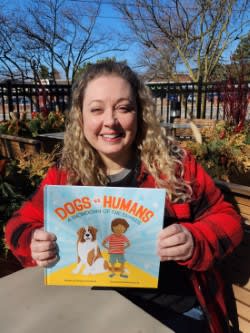
About the Author: Stephanie Gibeault
Stephanie Gibeault lives in Pickering, Ontario, and spent her summers in the Ottawa Valley, where her lifelong fascination with animals began. With a Bachelor of Science in ecology and evolution and a Master of Science in animal behaviour, she has built a career combining science and storytelling. From working as a biologist to becoming a certified professional dog trainer, Stephanie brings real-world expertise to her writing. Now a Canadian children’s author, she shares her passion for animals through engaging nonfiction and fiction for young readers.
About the Illustrator: Bambi Edlund
Bambi Edlund is a Canadian illustrator based in Powell River, British Columbia. Known for her whimsical and expressive style, she is also a needle felter, animator, and designer. Her work often reflects her love of animals and storytelling, bringing personality and humour to every page. Don’t miss our Hooked on Books interview with Bambi about her STEM book, Operation Cupcake, a 2025 Forest of Reading nominee.
About the Book
Dogs vs. Humans: A Showdown of the Senses is a lively nonfiction book for readers ages 6 to 9 that compares how dogs and humans experience the world through sight, smell, taste, touch, and hearing. Framed as a fun competition, each “round” highlights fascinating scientific differences and similarities between the two species. With engaging explanations and playful illustrations, the book introduces young readers to animal behaviour and sensory science while encouraging a deeper appreciation for their canine companions.
Read our Exclusive Interview with Stephanie Gibeault
Dogs vs Humans: A Showdown of the Senses takes a fun, competitive approach to science. What inspired you to frame the book as a “showdown” rather than a traditional nonfiction format?
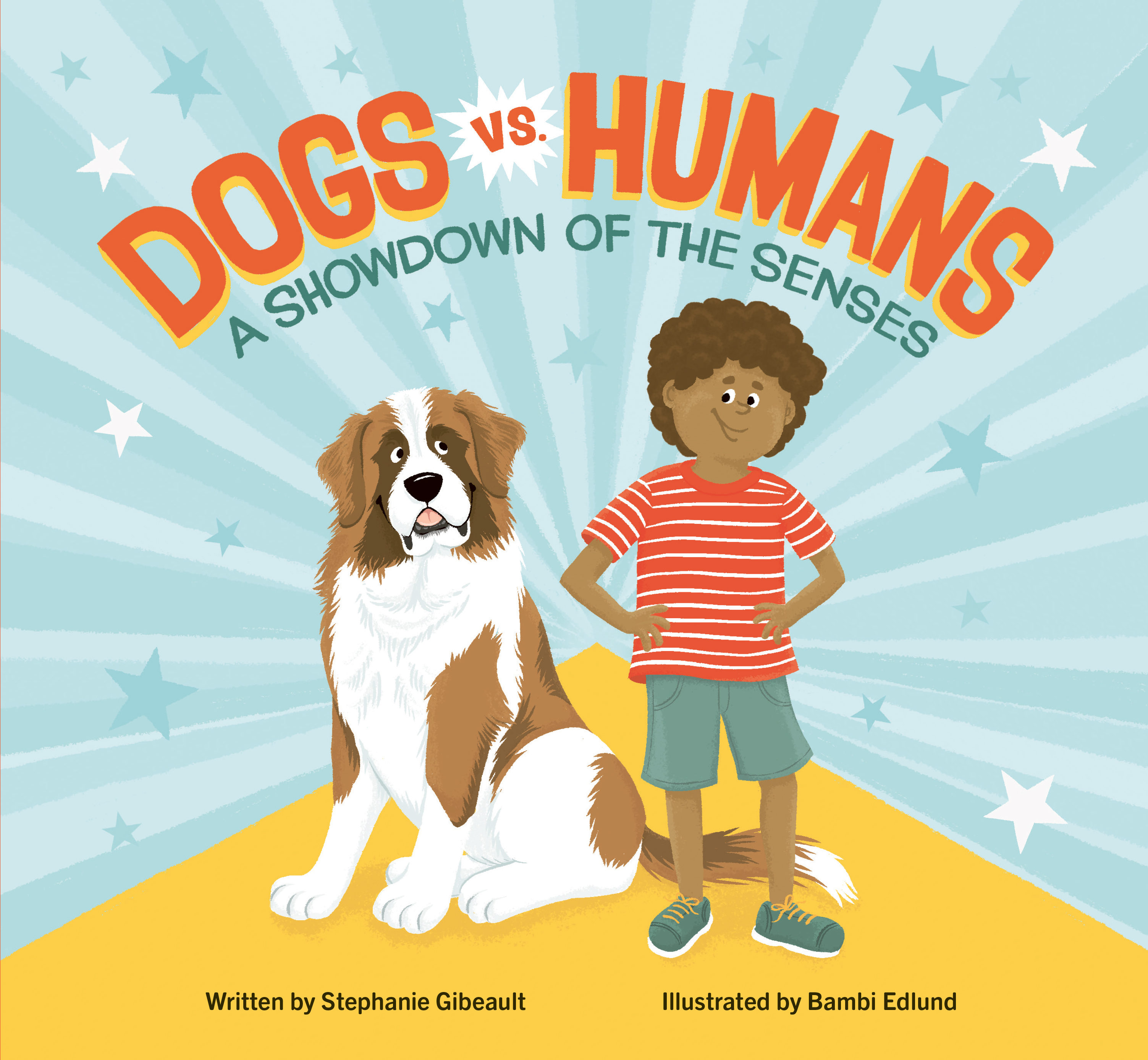
I was inspired to frame Dogs vs. Humans as a friendly competition between the two species because I wanted to illustrate a dog’s sensory point of view in a relatable way. I felt that comparing how a dog sees, hears, smells, etc. to how the child reader and other humans see, hear, and smell would make the differences more vivid and understandable. Plus, the reader gets to learn about their own senses at the same time as they learn about dogs. I also hoped a showdown would make the science more engaging for a younger audience as they could try to guess the winner for each category and track the running tally of points before the final reveal of who comes out top dog.
You have a background in animal behaviour and dog training. How did your real-life experiences with animals shape the content and accuracy of this book?
In my years as a dog trainer, I saw so many clients who interpreted their dogs’ actions through a human lens, seeing dogs as furry little people rather than incredible animals with their own way of experiencing and perceiving the world. That definitely influenced the content of the book because I wanted to foster an appreciation for a dog’s eye view. My academic background in animal behaviour meant I wanted to put the facts about sensory perception in a behavioural and ecological context. The book is about more than how dogs smell; it’s also about why they can smell so well and how that impacts their interactions with the world and with humans. As for accuracy, research is my superpower, so although I was already familiar with much of the science in the book, I did my utmost to ensure I had the most up-to-date facts while keeping the information easy to understand for kids.
The book compares how dogs and humans experience the world through their senses. What do you think is the most surprising difference that young readers will discover?
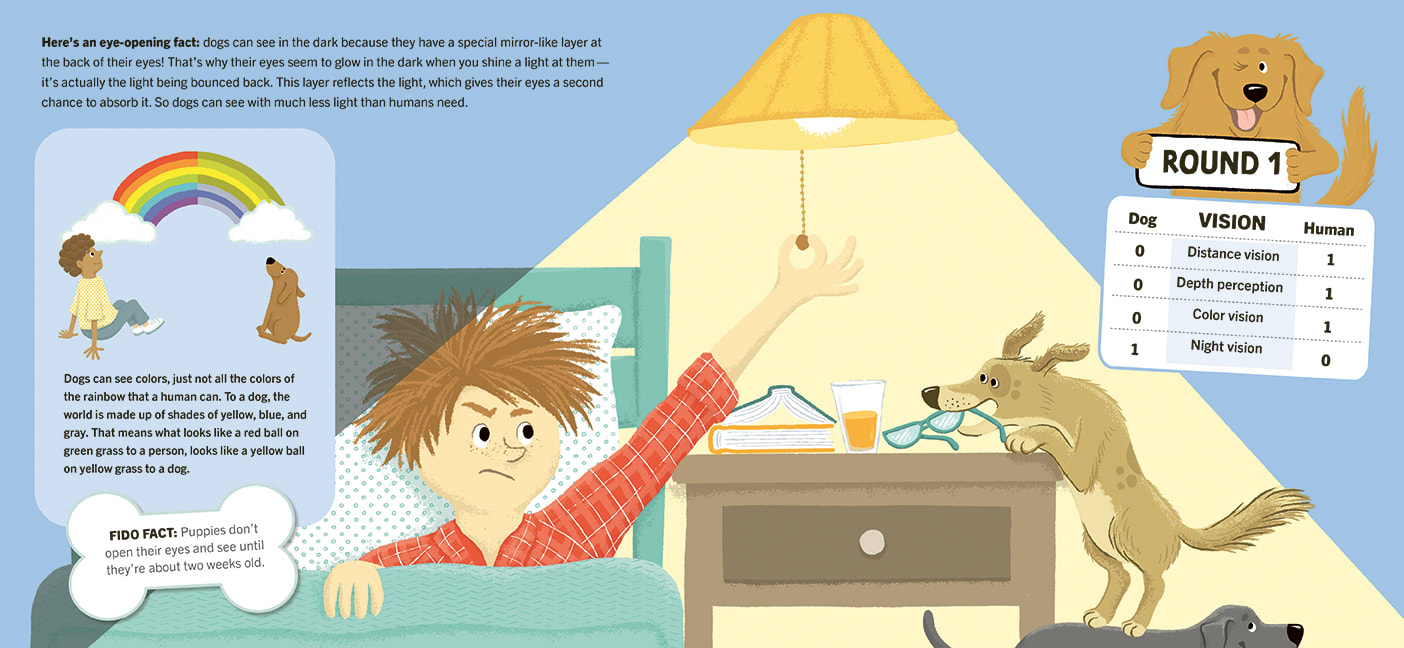
I think everybody already knows that dogs have super noses, so no bombshell there. But I do think that kids will be shocked to discover that some of their sensory abilities exceed those of dogs. For example, humans can see details in the distance more clearly and we have better depth perception. But the most surprising difference may be that humans have a far superior sense of taste. I also think kids will be fascinated to learn about magnetoreception, the ability to sense the Earth’s magnetic poles, which dogs use to line themselves up in a north-south direction when they poop!
Humour and science come together throughout the book. How do you balance keeping the content engaging and fun while still being educational?
I’m an info-kid at heart, so facts are inherently fun for me, but I want kids who are more reluctant when it comes to science to enjoy reading Dogs vs. Humans as well. So, I added silly jokes and word play to keep things funny and therefore more engaging. I think the showdown framework contributed to that too. By presenting the science in a fun package, kids don’t even realize how much they’re learning. It’s like getting cheese sauce on your broccoli. If the cheese is delicious enough, you don’t even notice you ate vegetables. And for the info-kids out there, the humour is a wonderful bonus.
Dogs vs. Humans introduces some fascinating scientific concepts in an accessible way. How can teachers use it in the classroom to support science learning or inquiry-based discussions?
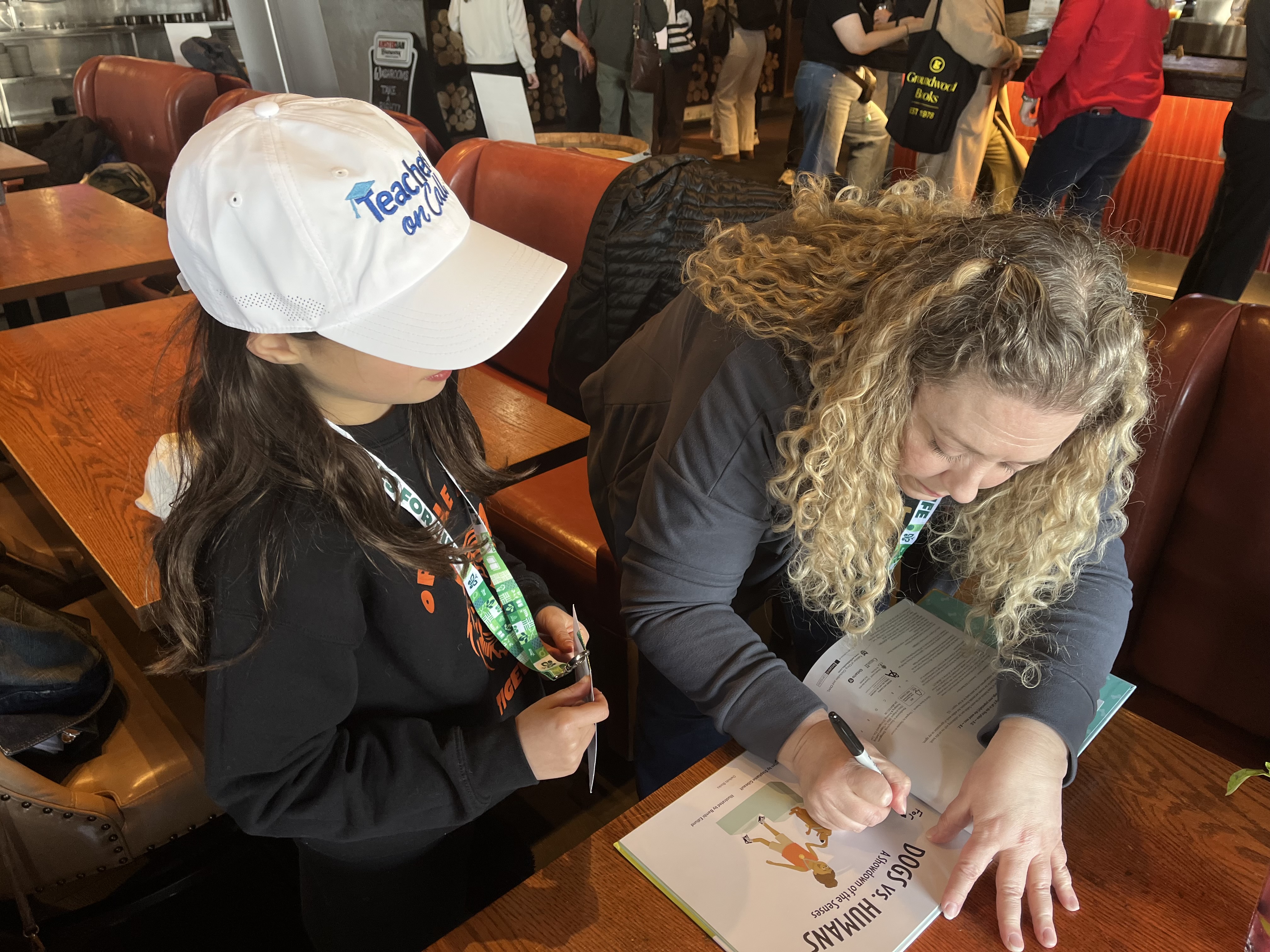
This book has curricular connections such as animal structures and their functions, diversity of life, and sensory perception, so it’s a great complement to lessons on those topics. The book would be perfect for “notice and wonder” exercises. Give the students a fact like dogs eat garbage and people don’t, or dogs can detect cancer, then ask the students to think about why that might be. After discussing, the book can be used to find the science behind the why. The book can also be used for research in the middle of a lesson as kids can collect facts about the different senses. And finally, at the end of a lesson, the students can dig deeper and compare species. For example, after learning about the structure and function of the eye, they can use the book to research how that differs between dogs and humans. Both have eyeballs, but the structures are slightly different leading to different sensory abilities such as reduced colour vision and better night vision in dogs. In addition, students can design simple experiments to test their own senses against those described in the book for dogs. Finally, and this is in the teacher’s discussion and activity guide available for free on my website, students can go on a sensory scavenger hunt to get a hands-on feel for what they learned in the book.
The illustrations play a big role in bringing the comparisons to life. How did you collaborate with Bambi Edlund to ensure the visuals supported the scientific ideas?
Bambi Edlund’s illustrations are absolutely adorable as well as scientifically accurate and do bring the comparisons to life. Bambi and I never spoke during the creation process; however, I did see her sketches and illustrations as the book progressed. Although Bambi did her own research, I was asked to fact check the scientific accuracy of each illustration and provide sources for further information. For example, getting the visual field of view down to the correct degree. My comments were passed along through my amazing editor Stacey Roderick who also generously allowed me to make suggestions on the book overall to ensure we were all happy with the final result. And I’m overjoyed!
The book is full of fun comparisons. Did you have a favourite “round” in the showdown while you were writing?
While I was writing, my favourite round in the showdown was vision. I think it contains some fun facts and it’s surprising that humans come out on top. I also loved imagining how Bambi’s illustrations could bring that to life. For example, the rainbow for colour vision. There is a myth that dogs see in black and white, but Bambi used the rainbow to illustrate which colours dogs can see by making one half of the rainbow as it appears to most humans and the other half as it appears to dogs.
For parents and educators, how could this book be used to spark conversations about empathy, especially when it comes to understanding animals and their needs?
I wanted this book to foster empathy in readers. By understanding how dogs experience their environment and the ecological reasons behind their behaviour, we can be better stewards for their care. For example, a dog wants to sniff everything on a walk because that’s how they gather the neighbourhood gossip. Rushing them along is cheating them of a very enriching experience. I think parents and educators can ask young people how they think certain situations might feel to a dog and what that dog might want most in that situation rather than assuming the dog feels like they do. And that expands to empathy for other people. This book can help kids gain context for appreciating different perspectives which they can apply to their family pets as well as their friends and peers.
~
At Teachers on Call, science is one of the most popular subjects we support through both in-home and online tutoring, whether it is general science, biology, chemistry, or physics. That is why books like Dogs vs. Humans, which help spark an early interest in science at the elementary level, are so meaningful in building curiosity, confidence, and a love of STEM learning from a young age.
In Dogs vs. Humans: A Showdown of the Senses, Stephanie Gibeault delivers a unique contribution to children’s nonfiction that is as educational as it is entertaining. With its engaging format, scientific depth, and thoughtful exploration of empathy, this book is a standout choice for classrooms and homes alike. Whether young readers are animal lovers, curious scientists, or both, this Forest of Reading nominee offers an unforgettable journey into understanding the world through more than one point of view.
Looking for more STEM books for a young reader in your life? Check out This Is How a Ball Rolls by Heather Tekavec, Ana’s Adventures at the Mine by Ana Gabriela Juárez, or Think Like a Goat by Lisa Deresti Betik, and Chomp-O-Rama by Maria Birmingham.
Related Articles View All
From an 1870s Classroom to a Modern University Campus: Family Learning at Doors Open Markham
Explore Markham’s past and present during Doors Open Markham, with 17 sites offering family-friendly adventures in history, art, architecture, education and culture.
Splashing Into Marine Science: "Octopus Ocean" with Canadian Author Mark Leiren-Young
Dive into the fascinating world of octopuses with Canadian author Mark Leiren-Young. Discover how Octopus Ocean: Geniuses of the Deep brings marine science, animal intelligence and ocean conservation to life for young readers.
From Theoretical Physics to a Ghost Village: Family Learning at Doors Open Waterloo Region
From theoretical physics to a ghost village, discover family-friendly learning adventures at 27 fascinating sites during Doors Open Waterloo Region 2026.
