

Children are natural scientists and engineers, constantly asking questions, building, experimenting and trying to understand how the world works. Canadian educator Stephen Holmes taps into that curiosity with The Adventures of Charlotte and Cameron, an independently published, interactive children’s book series inspired by his own two children. Created for young readers ages 4 to 9, the three stories combine playful adventures with robotics, chemistry, engineering, teamwork and hands-on problem-solving. Keep reading for our exclusive interview with Stephen Holmes about transforming his experience as a math and science teacher into engaging STEM books for children.
Parents and educators may find the series especially meaningful because it invites children to become active participants in each story. Rather than simply explaining scientific concepts, the books encourage readers to pause, make predictions, consider possible solutions and learn alongside Charlotte, Cameron and their robot friend, Sparx. The in-person and online tutoring service at Teachers on Call recommends The Adventures of Charlotte and Cameron as an approachable way to support science learning, build confidence and reinforce the idea that mistakes are a valuable part of discovery. The stories can also inspire simple experiments, design challenges and meaningful conversations at home or in the classroom.

About the Author: Stephen Holmes
Stephen Holmes is a middle school math and science teacher and the author of The Adventures of Charlotte and Cameron, a children’s book series inspired by his own two children. He grew up in Port Hope, Ontario, and attended high school in nearby Cobourg. Today, Stephen lives in Bradford and teaches in Aurora at St. Andrew’s College (15800 Yonge St, Aurora, ON L4G 3H7).
With more than a decade of experience in education, Stephen is passionate about making STEM engaging, interactive and accessible for young learners. His books combine storytelling with hands-on problem solving, encouraging children to ask questions, experiment and learn through curiosity. When he’s not teaching or writing, Stephen enjoys training for marathons, following Toronto sports teams, golfing and spending time with his family at the cottage.
About The Adventures of Charlotte and Cameron
The Adventures of Charlotte and Cameron is a three-book STEM series featuring two resourceful siblings and their friendly robot companion, Sparx. Throughout the stories, readers are encouraged to help the characters investigate problems, predict outcomes and test possible solutions.
In Fixing Sparx, Charlotte and Cameron must determine why their robot has suddenly stopped working. The story introduces technology, robotics, logical thinking and troubleshooting as the siblings examine tangled wires, missing parts and other possible causes.
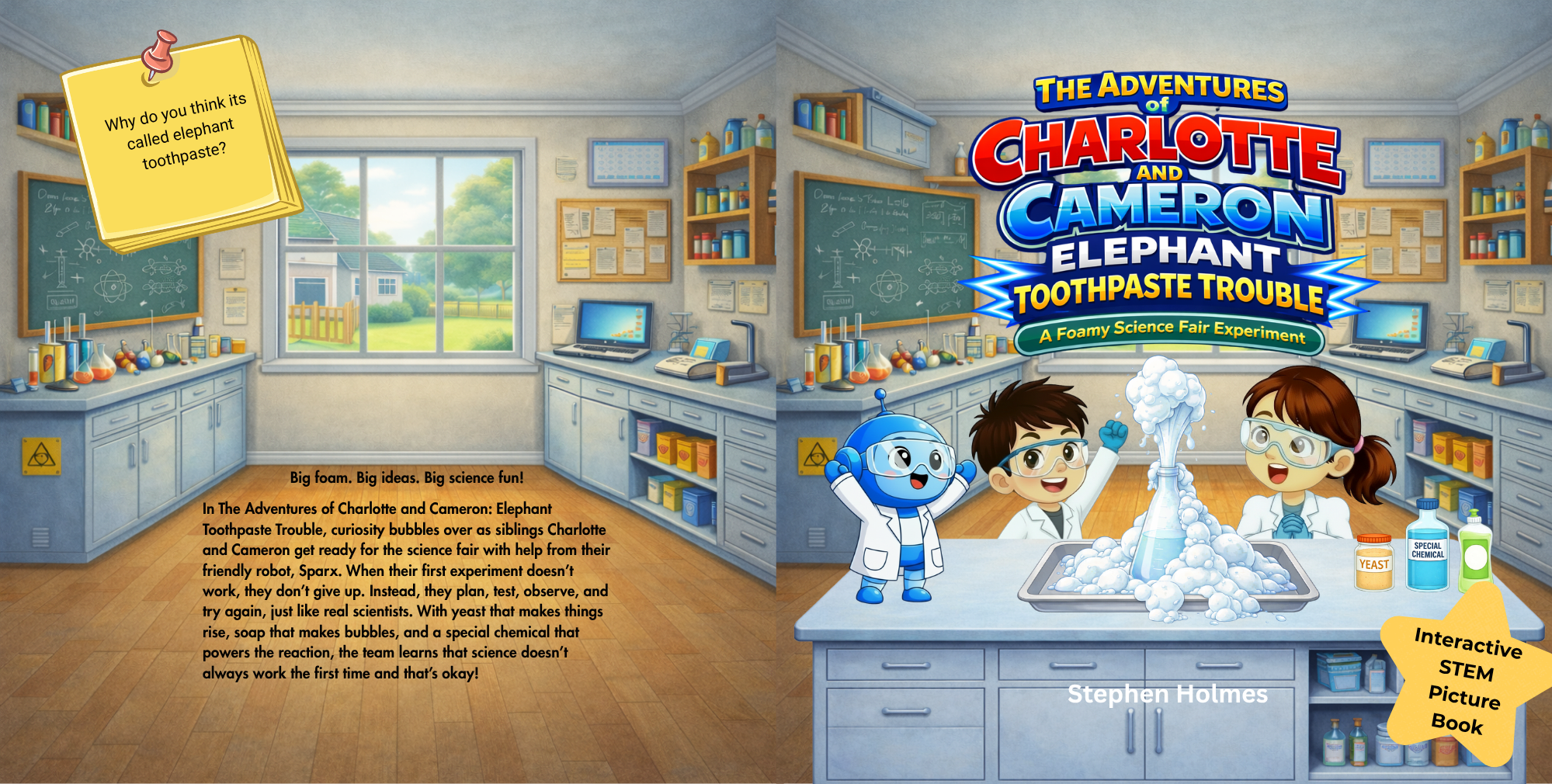
Elephant Toothpaste Trouble explores chemistry and the scientific method through an experiment that does not go as planned. When the expected foamy reaction fizzles, the characters revisit their steps, look for possible errors and discover how much can be learned from an unexpected result.
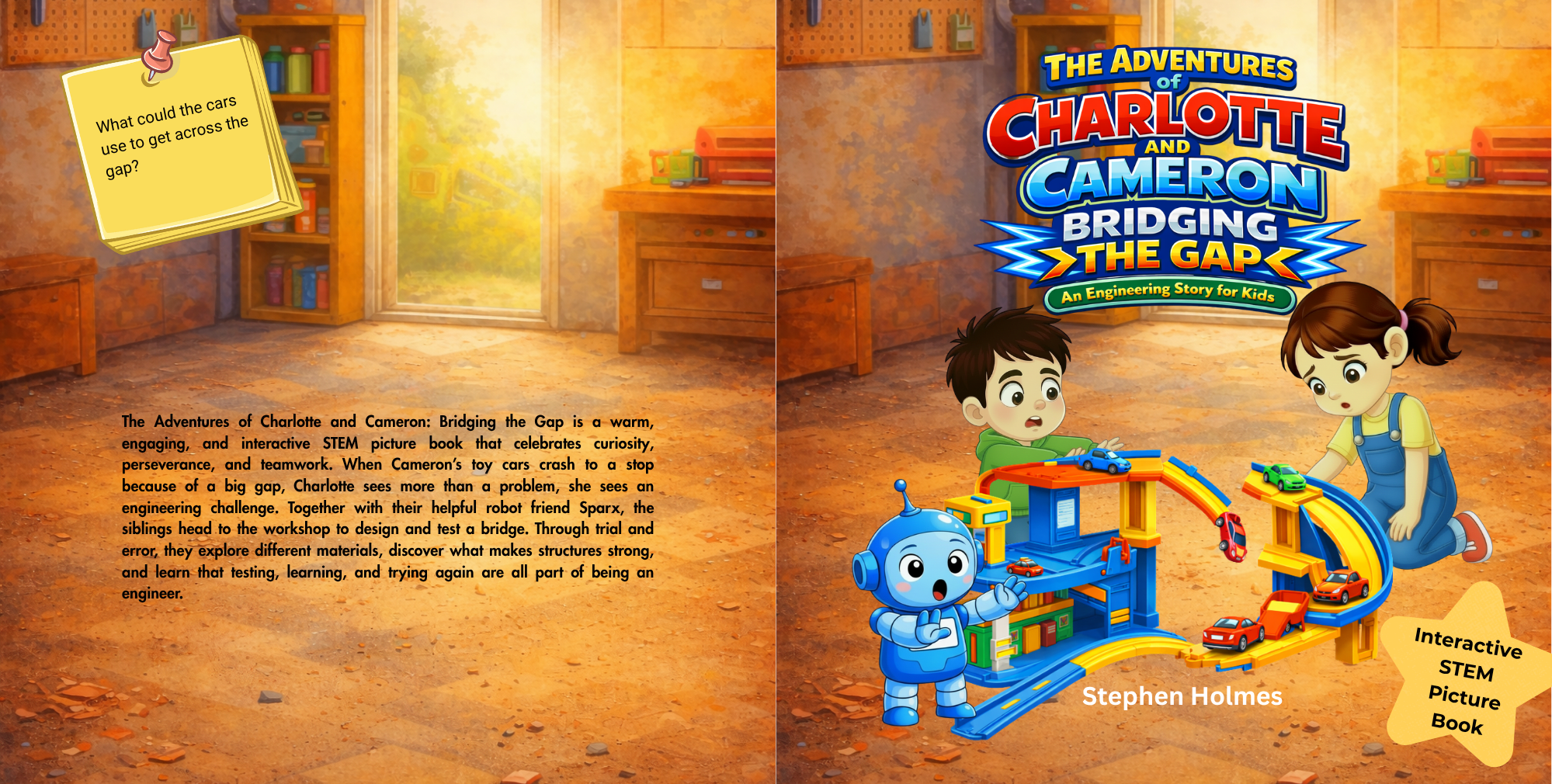
In Bridging the Gap, the siblings face an engineering challenge when their toy cars cannot cross a large gap. They design, build, test and improve a bridge while learning about structures, materials, prototypes and the importance of trying again.
Together, the books demonstrate that children do not need to know every answer before exploring STEM. Curiosity, creative thinking and a willingness to experiment are excellent places to begin.
Hooked on Books: An Interview with Canadian Author and Middle School Math and Science Teacher Stephen Holmes
As a middle school math and science teacher, you are used to bringing STEM concepts to life for the students in your classroom. How does it feel to now expand your reach as a children’s author, introducing STEM learning to young readers beyond your own classroom?
It’s been really rewarding. I’ve spent more than a decade teaching and trying to find ways to make math and science engaging and accessible for students, so it’s exciting to take some of those same ideas and reach children who may never be in my classroom. One of the coolest parts has been seeing where the books have ended up. They started as a side project at home, and now there are children reading them in different schools, libraries and even different countries. As a teacher, you’re always looking for that moment when a child becomes curious and wants to figure something out for themselves. If these books can create a few more of those moments outside my own classroom, that’s pretty special.
What inspired you to create The Adventures of Charlotte and Cameron, and how did the idea of combining storytelling with STEM learning first come together?
The books were inspired by my own children, Charlotte and Cameron, who became the main characters in the series. I had wanted to try writing a children’s book for a while, partly because I enjoy taking on side projects where I get to learn something completely new. Eventually I decided, “This is the year I’m going to figure out how to do it.” Originally, I actually pictured something much simpler: a short bedtime story that I could read with my own kids. But as I started learning about writing, illustrating and self-publishing, the project grew. Because I teach math and science, STEM was a natural direction to take it. I’ve always liked creating challenges for students where they have to actually use what they’re learning rather than just being told information. I started thinking about how I could do the same thing in a children’s story. Instead of Charlotte and Cameron simply learning about a robot or an experiment, I wanted them to encounter a problem and have to figure it out. From there, the idea became much bigger than a single book.
Through your years of teaching math and science, what have you learned about what makes children genuinely excited about STEM, and how has that influenced your approach to writing the series?
Kids become excited about STEM when there’s something to figure out. If you give them a challenge, an experiment, something to build or a problem where the answer isn’t immediately obvious, you see a completely different level of engagement. I’ve also learned that it needs to feel relevant to their world. That influenced the books quite a bit. I didn’t want the STEM challenges to feel abstract. Sparx is essentially their toy robot. The engineering problem involves a toy car garage and building a bridge for cars. Elephant toothpaste is a big, bubbly experiment that looks exciting and immediately gets kids asking questions. I wanted to take things children already find interesting and then sneak some fairly important STEM thinking into the experience, such as predicting, observing, testing, troubleshooting and trying again when something doesn’t work.
The series is geared toward children ages 4–9. Why did you want to introduce STEM concepts at this age, and what do you hope young readers take away from the books?
Children at that age are naturally curious. They ask an incredible number of questions, they build things, take things apart, notice patterns and constantly experiment with the world around them. In many ways, they’re already thinking like scientists and engineers. STEM has also become much more prominent in education over the last decade, and I wanted to find a way to introduce that type of thinking even earlier. I don’t remember having many books like this when I was that age, where you were reading an adventure but also being asked to stop, think and solve something alongside the characters. I’m not expecting a four-year-old to finish one of the books with a sophisticated understanding of chemistry or engineering. I want them to come away thinking, “That was cool,” or “I want to try that,” or asking, “Why did that happen?” If we can establish early on that science and math are things you explore rather than subjects you should be intimidated by, I think that has real value.
Can you introduce us to the three books in The Adventures of Charlotte and Cameron series and some of the different STEM concepts, experiments or challenges children encounter in each adventure?
The first book is Fixing Sparx. Sparx is Charlotte and Cameron’s robot, and one day he suddenly shuts down. They have to figure out what went wrong, work through tangled wires and missing pieces, and troubleshoot the problem until they can get him working again. That book introduces technology, robotics and logical problem solving, but it also introduces Sparx as a character who carries through the series.
The second book is Elephant Toothpaste Trouble. Charlotte and Cameron attempt the elephant toothpaste experiment, but it doesn’t work properly. Instead of getting the huge bubbly reaction they expect, the experiment fizzles. They have to go back, think about what they did, identify what might have gone wrong and try again. There’s some chemistry involved, but the bigger idea is really the scientific process, including making predictions, experimenting, observing and learning from an unexpected result.
The third is Bridging the Gap. Their toy cars need to cross a gap, so Charlotte, Cameron and Sparx head to the workshop to design and build a bridge. Their first design doesn’t necessarily work the way they expect, so they test it, identify weaknesses and improve it. That introduces children to engineering design, structures, materials and the idea of prototypes. There’s also a progression across the books that I like: technology and troubleshooting in the first, science and experimentation in the second, and engineering and design in the third.
The books encourage children to stop, think, problem solve and participate in the story. Why was it important to you to make STEM learning interactive and fun rather than simply explaining the concepts to readers?
That comes directly from teaching. If I immediately give students an answer, I’ve taken away the most interesting part of the learning. Throughout the books, there are points where the reader is asked to stop and think about what Charlotte and Cameron should do, make a prediction or help solve a problem. I wanted the child reading the book to become part of the adventure rather than just watching it happen. It also creates conversation between children and adults. A parent or teacher can stop and ask, “What do you think they should try?” The child might be right, they might be completely wrong, or they might come up with something I never considered. All three are valuable. And ultimately, they’re children’s books. They have to be fun. The learning works much better when children are engaged in the story first and discovering the STEM concepts along the way.
For Ontario teachers, what curriculum connections do you see within The Adventures of Charlotte and Cameron, particularly in Science and Technology and Mathematics? How could educators use the books and activities to extend learning in the classroom?
There are a lot of natural connections, particularly to the STEM skills and connections component of the Ontario Science and Technology curriculum. Students are identifying problems, making predictions, planning, testing ideas, observing results and communicating their thinking.
Bridging the Gap, for example, lends itself really naturally to the engineering design process. You could read the story and then give students materials and challenge them to design their own bridge. They could test how much weight it holds, compare designs and improve their prototypes.
Elephant Toothpaste Trouble could lead into a classroom investigation where students make predictions and observations and discuss why changing variables can affect the outcome of an experiment.
Fixing Sparx can lead into conversations about technology, robotics, coding, sequencing and troubleshooting. I think the books work best as a starting point. Read the story, stop at the problem and then let students become Charlotte and Cameron. Ask them to design the solution or conduct the investigation before finding out what happens in the book.
For parents and caregivers, what are some ways they can use the books at home to encourage curiosity, problem solving and an interest in STEM? Are there activities or conversations you would recommend continuing after the story ends?
Parents definitely don’t need to be science or math experts. In fact, one of the best things you can say when a child asks a question is, “I don’t know. How could we figure that out?” While reading, I’d encourage parents to actually use the stopping points in the books. Don’t rush to the next page. Ask your child what they think Charlotte and Cameron should do and, more importantly, ask why. Then you can extend it afterward. Build a bridge out of things you have around the house and see how many toy cars it can hold. Try a safe version of an experiment together. Take something that isn’t working and talk through how you might troubleshoot it. You can find STEM almost everywhere. Cooking involves measurement and chemistry. LEGO involves engineering and spatial reasoning. Going outside leads to questions about plants, animals, weather and forces. The biggest thing parents can encourage is the habit of asking questions and being willing to investigate the answers.
For students who may not see themselves as strong in math or science, how can parents and educators help build a growth mindset and greater confidence in STEM? How can The Adventures of Charlotte and Cameron be used to support that shift?
I think we need to move children away from the idea that being good at math or science means knowing the answer immediately. A lot of real STEM involves things not working. Engineers build prototypes that fail. Scientists conduct experiments that produce unexpected results. Programmers write code and then spend a huge amount of time figuring out why it isn’t working. Failure gives you information. That’s deliberately built into the series. The elephant toothpaste experiment doesn’t work properly at first. The bridge needs to be tested and improved. Sparx has a problem that Charlotte and Cameron have to diagnose. The characters aren't successful because they already know everything; they're successful because they keep working at the problem. For children who lack confidence in STEM, I think that distinction is really important. Instead of praising only correct answers, we can recognize good questions, persistence, creative approaches and the willingness to change strategies. The message I’d like children to get from the books is that you don’t have to already be “good at science” to be a scientist. You start by being curious.
What’s next for Stephen Holmes? Are there more books, classroom projects or other ways you hope to continue bringing STEM learning to life for young people?
For now, I feel like the trilogy is complete. I have plenty of ideas for more adventures, but I also don’t want to create another book just for the sake of adding another title to the series. The obvious missing piece is a book with a stronger mathematics focus. As a math teacher, I find that funny because math is such a huge part of what I do every day, but it’s also a little more challenging to turn into the kind of visual, exciting adventure that works for a four- or five-year-old. I have some ideas in the back of my mind, though.
More recently, I’ve also been working on projects that connect directly to my own classroom. I’ve been developing a math workbook for my courses and working on a science app that can supplement what I’m teaching in class. Both projects have given me another opportunity to think creatively about how students learn and how we can make STEM content more engaging, interactive and accessible. The whole book project started because I wanted to learn how to publish a children’s book. That process ended up involving writing, publishing, design, illustration and technology. I enjoy learning new things and taking on projects where I don’t completely know what I’m doing at the beginning, and I think the workbook and science app are really a continuation of that. Whether the next project is another Charlotte and Cameron book, something for my own students or something completely different, I’d like it to keep coming back to the same idea: getting kids curious, giving them interesting problems to solve and making learning something they genuinely enjoy.
~
The Adventures of Charlotte and Cameron demonstrates how storytelling can turn STEM concepts into problems children genuinely want to solve. By inviting young readers to repair a robot, investigate a fizzled experiment and strengthen a bridge, Stephen Holmes encourages them to ask questions, test their ideas and view unexpected results as opportunities to learn.
Stephen Holmes is part of a broader community of Canadian educators finding creative ways to inspire the next generation of scientists and problem-solvers. Across Ontario, teachers are bringing STEM education to life, including an Ottawa science teacher recognized nationally for teaching excellence in STEM and making science fun.
Through our Hooked on Books series, Teachers on Call is pleased to feature a Canadian educator using books to make science, technology, engineering and mathematics feel accessible, creative and fun. Most importantly, the series reminds children that they do not need to have every answer to begin exploring. They simply need to be curious.
Interested in exploring more books with young STEM fans? Check out our interview with Toronto-based Ana Gabriela Juárez for Ana’s Adventures at the Mine or Operation Cupcake: How Simple Machines Work by Vancouver-local Bambi Edlund.
Related Articles View All
Forest of Reading 2027 Nominees Announced: Discover Canadian Children’s Books in English and French
The Forest of Reading 2027 nominees are here! This year’s lineup celebrates diverse Canadian authors and illustrators from coast to coast, with books in English and French for readers of all ages. Explore the full list and discover which stories students across Canada will be reading—and voting for—this spring.
From Stop-Motion to Stories of Freedom: Family Learning at Doors Open Chatham-Kent
Explore stop-motion animation, Black history, art, nature and more at 13 Doors Open Chatham-Kent sites offering family-friendly learning across the region.
